
Quick answer: Iceland drives on the right-hand side of the road, and you overtake on the left. That is the same side as the United States, Canada, and most of mainland Europe. Rental cars in Iceland are left-hand drive, with the steering wheel on the left, so for most visitors the setup feels familiar from the moment they leave the car park. The rule never changes by season or region: it is right-hand traffic on the Ring Road, on gravel roads, in Reykjavik, and in winter. What does change is the driving itself, because Iceland’s weather, gravel surfaces, single-lane bridges, and two-lane roundabouts demand more attention than the side of the road ever will.
The short answer, and why it confuses some travellers
If you are used to driving on the right, there is nothing to relearn about which side to use. You keep right, you pass on the left, and you turn into the right-hand lane. If you come from the United Kingdom, Ireland, Australia, New Zealand, South Africa, or Japan, where traffic keeps left, Iceland will feel like a mirror image for the first day or two. The logic of the road is the same; only the side is flipped.
That mirror effect is exactly why the question gets asked so often. Iceland is a popular self-drive destination, and many visitors arrive from both right-driving and left-driving countries. Add in a landscape that looks nothing like home, road signs in Icelandic, and a rental car picked up after a long flight, and it is sensible to check the basics before turning the key.
The reassuring part is that Iceland has no regional exceptions, no seasonal switch, and no left-driving enclaves. You do not have to remember a different rule for the highlands, for Reykjavik, or for winter. Learn it once, and it holds everywhere in the country.
What right-hand driving means in practice
Driving on the right is more than a slogan. It shapes every manoeuvre you make, and the details matter most in the moments when habit takes over.
- Normal driving: Keep to the right-hand lane. On a two-lane road, the right lane is your travelling lane and the left lane is for overtaking only.
- Overtaking: Pass on the left, and only when the road ahead is clear, the markings allow it, and you can complete the pass safely. Return to the right lane once you are past.
- Turning left: You cross the oncoming lane, so you wait for a safe gap, just as you would at home in a right-driving country.
- Turning right: You turn into the nearest right-hand lane, without crossing oncoming traffic.
- Junctions: Traffic already on the road generally has priority over traffic entering it, unless signs or signals say otherwise. At uncontrolled junctions, the usual rule is to yield to traffic approaching from the right.
- Roundabouts: Give way to traffic already circulating in the roundabout. In Iceland’s two-lane roundabouts, there is an important local rule covered below: the inner lane has priority when exiting.
None of this is exotic. For a right-driving visitor, it is the same system you already know. For a left-driving visitor, it is the same system with the sides swapped, which is why the first few junctions, car parks, and roundabouts deserve your full attention.
If you normally drive on the left: how to adjust
Most left-driving visitors adjust quickly, and the danger period is short but real. The risk is rarely while you are cruising along a straight road. It is in the moments when you are not yet thinking about the road at all: pulling out of a car park, leaving a petrol station, turning at a quiet junction, or starting again after a photo stop. Those are the moments when old muscle memory can quietly take over.
A few habits help more than any amount of worrying:
- Say it out loud at first. For the first day, say “keep right” as you pull away from every stop. It sounds silly, and it works, because it replaces an automatic habit with a deliberate one until the new habit forms.
- Follow the car in front. On your first drive, let another vehicle lead you out of town if you can. Following its line through junctions and roundabouts keeps you on the correct side without you having to think about it at every turn.
- Use your passenger as a second pair of eyes. Ask them to watch your lane position at junctions and after stops, and to speak up immediately if you drift left.
- Watch the signs, not just the road. Road markings, arrows, and the direction other cars face all confirm the correct side. If you are ever unsure after a stop, look at which way parked cars face and which side of the road other drivers are using before you move.
- Take the first drive slowly. Plan a short, easy first leg, ideally in daylight and outside rush hour in Reykjavik.
- Be extra careful at roundabouts and car parks. These are the two places where left-driving visitors most often slip. Treat every roundabout entry as a fresh decision, and check your lane twice when leaving a car park.
Most visitors find the adjustment is done within a day. By the second morning, keeping right feels normal, and the real challenges of Icelandic driving — weather, gravel, and narrow bridges — take over.
Roundabouts: Iceland’s one rule that surprises visitors
Roundabouts deserve a section of their own, because Iceland has a rule that catches out drivers from both sides of the road. In a two-lane roundabout, the inner lane has priority over the outer lane when exiting. In practice, that means a driver in the inner lane who is leaving the roundabout has the right of way over a driver in the outer lane who is continuing around it.
This is different from the rule many visitors are used to, where the outer lane is often treated as the natural exiting lane. In Iceland, if you are in the outer lane and the car beside you in the inner lane signals to exit, you need to yield and let it cross in front of you. It feels counter-intuitive at first, and it is one of the most common causes of roundabout scrapes involving tourists.
The practical advice is simple: choose your lane before you enter, based on your exit. For a first or second exit, the outer lane is usually natural. For a later exit, the inner lane may be the right choice. Signal your exit clearly and early. If you are in the outer lane and unsure, slow down and be ready to yield to an inner-lane car that is exiting. If you miss your exit, do not swerve across lanes. Go around again.
Single-lane roundabouts are simpler: yield to traffic already circulating, enter when there is a safe gap, and exit from the same lane. Reykjavik has the busiest roundabouts, so if you are nervous, plan your first roundabout for a quieter road outside the capital.
Single-lane bridges: slow down and read the approach
Single-lane bridges are common on rural Icelandic roads, including stretches of the Ring Road. Only one vehicle can cross at a time, so someone has to wait. The rule is straightforward: whoever reaches the bridge first, or is clearly closer, has priority. Slow down well before the bridge so the situation is obvious to both drivers, and do not rush onto it hoping the other driver will stop.
Most single-lane bridges have a passing place or a widened approach on one side. If you arrive second, pull into it and wait. If you arrive first, cross steadily without stopping in the middle to take photographs. A bridge is not a viewpoint, and stopping on it blocks the only route for everyone behind you.
The same patience applies to narrow gravel sections and blind crests. Icelandic rural roads are often narrower than visitors expect, with soft or uneven shoulders. If you need to pull over, find a proper lay-by or a paved parking area rather than stopping on the shoulder, where the surface can be soft and passing traffic moves fast.
Speed limits in Iceland
Speed limits are lower than many visitors expect, and they are maximums for good conditions, not targets. On a wet, windy, or icy road, the safe speed is often well below the posted limit. The general limits, unless a sign states otherwise, are:
| Road type | Speed limit | In miles per hour |
|---|---|---|
| Urban areas and towns | 30-50 km/h | About 19-31 mph |
| Rural gravel roads | 80 km/h | About 50 mph |
| Rural paved roads | 90 km/h | About 56 mph |
A few points matter more than the numbers themselves. First, the urban limit is often 30 km/h in residential streets and near schools, so do not assume 50 km/h everywhere in town. Second, the gravel limit of 80 km/h is a legal ceiling, not a comfortable cruising speed; on loose gravel, most drivers are safer well below it. Third, speed cameras are used, fines are steep, and rental companies pass fines on to the renter with an administration fee on top. Driving to the conditions, rather than to the limit, is both safer and cheaper.
The other rules that matter more than the side of the road
Once you know you drive on the right, these are the rules that actually shape a safe trip in Iceland:
- Headlights on at all times. Icelandic law requires headlights to be switched on day and night, all year round, whatever the weather. Most rental cars handle this automatically, but check before you leave the lot.
- Seatbelts for everyone. Seatbelts are mandatory for every occupant, front and back.
- Alcohol limit of 0.02%. Iceland has one of the lowest drink-driving limits in the world, at 0.02% blood alcohol. In practice, that means do not drink and drive at all. Penalties are severe.
- Mobile phones. Using a hand-held phone while driving is forbidden. Set navigation before you move.
- Off-road driving is illegal. Driving off marked roads and tracks is strictly prohibited, to protect Iceland’s fragile landscape. Fines are large, and rental insurance does not cover off-road damage.
- Stopping on the road is dangerous and often illegal. Use designated parking areas, even if it means walking a little further.
- Animals on the road. Sheep roam freely in many rural areas, especially in summer. Slow down, expect them to change direction unpredictably, and never assume one sheep means there are no more nearby.
Gravel roads and F-roads: where the side of the road stops being the story
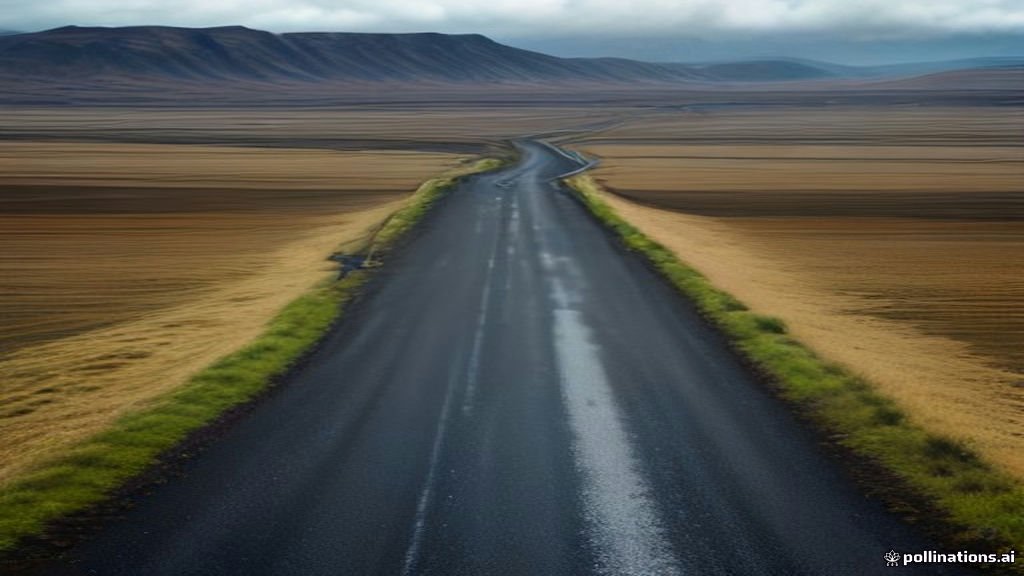
A large part of Iceland’s road network beyond the Ring Road is gravel, and the highlands are served by F-roads, mountain tracks marked with an F prefix, such as F26 or F208. Both change the driving experience far more than the side of the road does.
On gravel, grip is lower, stopping distances are longer, and loose stones can chip paint and windscreens. Keep your speed down, avoid sudden steering or braking, and keep a generous gap to the car in front. If you meet another car on a narrow gravel road, slow down and move right as far as the surface safely allows; the shoulder may be soft, so do not drop a wheel off the edge at speed.
F-roads are a different category entirely. They are only open in summer, they are unpaved, they often involve unbridged river crossings, and by law only four-wheel-drive vehicles may use them. Taking a standard car onto an F-road voids your insurance, breaks most rental agreements, and can lead to serious fines. Check road conditions on road.is before any highland route, and do not attempt an F-road unless your vehicle, your experience, and the conditions all suit it.
Renting a car and licences: what visitors need
Most visitors rent, and the rental setup reinforces right-hand driving: Icelandic rental cars are left-hand drive, with the steering wheel on the left. Left-driving visitors still sit on the left, which is itself part of the adjustment, because your road position and your view of the road edge both change.
Licence rules are straightforward for most tourists. A valid driving licence from your home country is generally accepted for tourist driving if it uses the Latin alphabet, and it must have been held for at least a year. Visitors from countries whose licences do not use the Latin alphabet should carry an International Driving Permit as well. Your licence is normally valid for tourist driving for up to six months, which covers any normal holiday.
Before you leave the rental lot, check that the headlights work and are set to on, that you know how to operate the windscreen wipers and demister for sudden rain, that the tyres suit the season, and that you have the rental company’s emergency number saved. In winter, ask specifically whether the car has winter tyres and what to do if conditions close a road.
Weather and seasons: the real adjustment
Iceland’s weather changes fast, in every season, and it is the single biggest difference between driving in Iceland and driving at home. A calm, sunny morning can turn into driving rain, strong crosswinds, or fog by afternoon, and winter adds ice, snow, and very short daylight hours.
Check the forecast and road conditions every morning, and again before any long leg. The Icelandic Road and Coastal Administration’s road.is site and the safetravel.is service are the standard sources. If a road is closed, it is closed for a reason; do not drive around a closure barrier.
In winter, plan shorter driving days, keep the fuel tank at least half full, and carry warm clothing, food, water, and a charged phone in the car. Wind is a particular hazard for high-sided vehicles such as campervans. If the wind warning is severe, the safest choice is to wait it out.
In summer, the challenge is different: long daylight hours tempt drivers to keep going long after they should have stopped. Fatigue is a real risk on a long Ring Road day, especially after an early flight. Plan an overnight stop, share the driving if you can, and take proper breaks.
Common mistakes visitors make
- Driving at the limit on gravel. Eighty kilometres per hour is the ceiling, not a recommendation.
- Stopping on the shoulder for photographs. Use a lay-by or car park.
- Underestimating distances. The Ring Road is about 1,332 kilometres around the island. A “quick” leg between towns can still take hours.
- Ignoring wind warnings. Wind can close roads to certain vehicles and can damage rental cars.
- Forgetting the roundabout rule. The inner lane has priority when exiting a two-lane roundabout.
- Driving tired after arrival. An early-morning arrival followed by a long drive is a risky combination. Rest first, drive second.
- Assuming fuel is always nearby. In remote areas, petrol stations can be far apart. Refuel when you can, not when you must.
Frequently asked questions
What side of the road does Iceland drive on?
Iceland drives on the right-hand side of the road, with overtaking on the left. The rule applies everywhere in the country, in every season, and to every type of road, from Reykjavik streets to rural gravel roads.
Is Iceland left-hand or right-hand drive?
Iceland is a right-hand traffic country with left-hand drive cars. Traffic keeps right, and the steering wheel is on the left side of the car, the same setup as in the United States and most of mainland Europe.
Do I need to adjust if I come from the UK or Australia?
Yes, but only briefly. If you normally drive on the left, you will need to consciously keep right, especially at junctions, roundabouts, and car parks, for the first day or so. Most visitors adjust within a day.
What is the speed limit in Iceland?
The general limits are 30-50 km/h in towns, 80 km/h on rural gravel roads, and 90 km/h on rural paved roads, unless signs state otherwise. These are maximums for good conditions; drive slower in rain, wind, ice, or on loose gravel.
Can tourists drive in Iceland with a foreign licence?
Yes, in most cases. A valid home-country licence in the Latin alphabet, held for at least a year, is generally accepted for tourist driving for up to six months. If your licence does not use the Latin alphabet, carry an International Driving Permit as well.
Are Iceland’s roads safe for first-time visitors?
Yes, with preparation. The Ring Road is paved and well maintained, traffic outside Reykjavik is light, and the rules are straightforward. The main risks are weather, gravel surfaces, single-lane bridges, and fatigue, all manageable with planning and sensible speeds.
What should I do at a single-lane bridge?
Slow down early. Whoever reaches the bridge first, or is clearly closer, goes first. If you arrive second, wait in the passing place. Cross steadily, without stopping in the middle.
Does the side of the road change in winter?
No. Iceland drives on the right all year round. Winter changes traction, visibility, and daylight, not the side of the road.

The bottom line
Iceland drives on the right, and overtakes on the left, exactly like the United States and most of Europe. For most visitors, that is the easiest part of driving in Iceland. The harder, more rewarding part is learning the local details that sit around that simple rule: the inner-lane roundabout priority, single-lane bridge etiquette, lower speed limits, headlights at all times, and the sheer speed with which Icelandic weather can change a road.
Learn the side, respect the roundabouts and bridges, drive to the conditions rather than the limit, and check road.is before you set out. Do that, and Iceland’s roads — from the Ring Road to a quiet gravel track in the Westfjords — become one of the best parts of the trip, rather than something to worry about.
Disclaimer: This article is general travel information, not legal advice. Road rules and fines can change, so check the current guidance from the Icelandic Road and Coastal Administration and your rental company before you travel.
