
Quick Answer
How to make buttermilk from half and half? Pour 1 cup of half and half into a measuring cup, stir in 1 tablespoon of fresh lemon juice or white vinegar, and let it sit for 5 to 10 minutes. The acid makes the dairy thicken slightly and curdle, giving you a tangy liquid that works as a 1-to-1 substitute for store-bought buttermilk in pancakes, biscuits, cakes, muffins, fried chicken, and dressings. Use it right away for the best results.
Why Half and Half Makes the Best Buttermilk Substitute
Most buttermilk substitute recipes start with whole milk. They work, but they miss something: real cultured buttermilk is thick. Whole milk mixed with acid stays thin, closer to sour milk than to the rich, pourable buttermilk from a carton.
Half and half fixes that. It is half whole milk and half light cream, with roughly 10 to 12 percent milk fat — about three times the fat of whole milk. That extra fat is exactly why the finished substitute coats a spoon, clings to fried chicken, and gives biscuits a tender crumb.
Recipe testers who compared milks side by side reached the same conclusion. In controlled tests, half and half mixed with acid produced the substitute closest to real buttermilk in thickness, appearance, and taste, with whole milk a close second. If you have half and half in the fridge, it is the best starting point you have.
There is one honest trade-off: the substitute is richer than real buttermilk. Cultured buttermilk has only about 1 to 2 percent fat and roughly 100 calories per cup. Half and half has about 315 calories per cup. In a batch of pancakes or a cake, that difference is small — a cup of substitute spread across a whole recipe adds a little richness, not a ruined dish. For dressings and fried-chicken dredges, the extra richness is actually an advantage.
What You Need
You need exactly two ingredients, plus a measuring cup and a spoon. No culturing, no special equipment, no waiting overnight.
| Item | What to use | Notes |
|---|---|---|
| Half and half | 1 cup, any brand | Full-fat works best; fat-free half and half thickens poorly |
| Acid | 1 tablespoon fresh lemon juice or white vinegar | Bottled lemon juice works; see the acid comparison below |
| Measuring cup | Liquid measuring cup | So you can see the level and stir in it |
| Spoon | Any spoon or small whisk | For mixing |
That is the whole list. If you want a slightly tangier result, use 2 tablespoons of acid instead of 1 — both amounts appear in tested recipes, and the difference is a matter of taste, not chemistry. One tablespoon gives a mild tang and a gentle thickening; two tablespoons gives a sharper tang and a visibly thicker, more curdled texture that lands even closer to cultured buttermilk.
How to Make Buttermilk from Half and Half: Step by Step
Step 1 — Measure the half and half. Pour 1 cup of half and half into a liquid measuring cup. Room-temperature half and half curdles a little faster than ice-cold, but either works. If yours just came out of the fridge, give it an extra minute or two of resting time.
Step 2 — Add the acid. Stir in 1 tablespoon of fresh lemon juice or distilled white vinegar. Pour the acid in slowly and stir as you go so it distributes evenly. If you dump it all in one spot, you can get uneven curdling — thick in one place, thin in another.
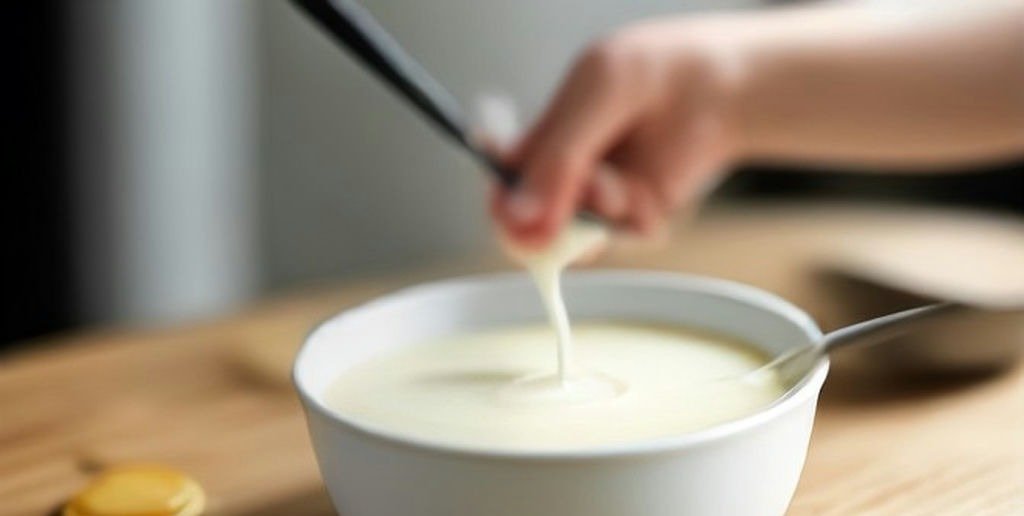
Step 3 — Rest for 5 to 10 minutes. Leave the cup on the counter, undisturbed. You will see the mixture thicken slightly and develop small curds. That curdled look is exactly what you want — it is the sign the acid has done its job. Ten minutes gives the fullest thickening; five minutes is enough if you are in a hurry.
Step 4 — Stir and use. Give the mixture a final stir and use it immediately, exactly as you would use store-bought buttermilk. One cup of this substitute replaces one cup of buttermilk in any recipe.
The whole process takes ten minutes at most, and most of that is waiting. The active work is under a minute.
Scaling the Recipe Up or Down
Recipes rarely call for exactly one cup of buttermilk. The ratio scales cleanly: keep 1 tablespoon of acid per cup of half and half, and adjust both together.
| Buttermilk needed | Half and half | Lemon juice or vinegar | Rest time |
|---|---|---|---|
| 1/4 cup | 1/4 cup (4 tablespoons) | 3/4 teaspoon | 5 minutes |
| 1/2 cup | 1/2 cup (8 tablespoons) | 1 1/2 teaspoons | 5–10 minutes |
| 3/4 cup | 3/4 cup (12 tablespoons) | 2 1/4 teaspoons | 5–10 minutes |
| 1 cup | 1 cup | 1 tablespoon | 5–10 minutes |
| 1 1/2 cups | 1 1/2 cups | 1 1/2 tablespoons | 10 minutes |
| 2 cups | 2 cups | 2 tablespoons | 10 minutes |
For very small amounts, measuring three-quarters of a teaspoon is awkward. A simpler rule works: for a quarter cup, use a generous half teaspoon of acid and let it rest the full ten minutes. The exact acid level matters less at small scale, because the acid is only there to add tang and trigger thickening, not to hit a precise pH.
One warning about scaling up: do not make a big batch to store. This substitute is best made fresh, in the amount your recipe needs.
Make what you need, when you need it.
Which Acid Should You Use?
Lemon juice and white vinegar are the two standard choices, but they are not the only ones. Each acid brings a slightly different flavor, and the right pick depends on what you are cooking.
| Acid (per 1 cup half and half) | Flavor it adds | Best for | Watch out for |
|---|---|---|---|
| Fresh lemon juice (1 tablespoon) | Bright, clean citrus tang | Pancakes, cakes, muffins, biscuits, dressings | Lemon flavor can show through in delicate vanilla cakes |
| Distilled white vinegar (1 tablespoon) | Neutral, sharp tang | Fried chicken, savory baking, anything where lemon would clash | None — the most neutral choice |
| Apple cider vinegar (1 tablespoon) | Mild, faintly fruity tang | Muffins, quick breads, spice cakes | Slight amber tint; avoid in white cakes |
| Cream of tartar (1 3/4 teaspoons) | Almost no flavor | Cakes and frostings where liquid matters | Add it dry to the flour instead; it is not a liquid acid |
| Plain yogurt or sour cream (1/4 cup + 3/4 cup half and half) | Rich, cultured tang | Dressings, dips, ranch | Thickens a lot — thin with a splash of milk if needed |
White vinegar is the safest all-purpose pick because it adds acidity without adding flavor. Fresh lemon juice is the best pick when a little brightness helps the dish, which is most baking. Apple cider vinegar works but can tint pale batters. Cream of tartar is a special case: it is a dry acid, so mix it into your dry ingredients and use plain half and half as the liquid.
What about lime juice? It works the same way as lemon juice, in the same amount, but its flavor is stronger and more distinctive. Save it for recipes where lime already belongs, like a lime cake or a southwestern dressing.
Half and Half vs. Whole Milk vs. Real Buttermilk
It helps to see the three side by side, because the differences explain both why the substitute works and where it falls short.
| Real cultured buttermilk | Half and half + acid | Whole milk + acid | |
|---|---|---|---|
| Fat per cup | ~2 grams | ~28 grams | ~8 grams |
| Calories per cup | ~100 | ~315 | ~150 |
| Thickness | Thick, pourable | Thick, close to real | Thin, like sour milk |
| Tang | Cultured, complex | Clean, sharp | Mild |
| Baking soda reaction | Strong | Strong | Moderate |
| Best use | Everything | Baking, frying, dressings | Baking only |
The fat gap is the big one. Real buttermilk is a low-fat product — the fat was churned out as butter, which is how it got its name. Half and half is a high-fat product. That is why the substitute is thicker and richer, and why it shines in fried chicken dredges and ranch dressing, where richness helps.
The acidity gap matters too. Cultured buttermilk gets its tang from live bacterial cultures, which produce a complex, slightly earthy sourness. Acidified half and half gets its tang from one acid, so the flavor is cleaner and simpler. In baked goods, where the buttermilk is one flavor among many, nobody can tell the difference. In a raw dressing, a careful taster might notice the cultured version is a touch more complex — but the half-and-half version is still very good.
The Baking Soda Rule You Cannot Skip
This is the part most short recipes leave out, and it is the part that decides whether your baking rises or falls flat.
Buttermilk is acidic — cultured buttermilk sits around pH 4.5. That acidity is not just flavor. In baking, it reacts with baking soda (an alkali) to release carbon dioxide, which is what lifts the batter. A recipe that calls for buttermilk and baking soda was written as a matched pair: the acid and the soda are meant to work together.
Your homemade substitute keeps that pairing intact, because you added acid to the half and half. So the rule is simple: if your recipe calls for buttermilk and baking soda, use the substitute exactly as written and change nothing. The acid in your substitute activates the soda the same way real buttermilk would.
The mistake is using plain half and half — with no acid added — in place of buttermilk. Plain half and half is not acidic enough to activate the baking soda. The soda stays mostly unused, and unused baking soda leaves a flat, yellowish crumb and a faint soapy or metallic taste. If you ever find yourself with no acid at all, you have two options: either add the acid and make the substitute properly, or swap the baking soda for baking powder (which carries its own acid) at a ratio of about 3 teaspoons of baking powder per teaspoon of baking soda — and even then, expect a slightly different rise.
What to Use It In
This substitute works anywhere a recipe calls for buttermilk. Some uses are better than others.
Where it is excellent:
- Pancakes and waffles. The acid reacts with the baking soda for a tall, fluffy rise, and the extra fat keeps the crumb tender. This is the single best use for the half-and-half version.
- Biscuits and scones. Richness is a feature here. The substitute produces a tender, flaky biscuit with a gentle tang.
- Fried chicken dredge. Soak chicken in the substitute before dredging in seasoned flour. The acid tenderizes the meat slightly, and the thickness helps the coating cling. Many fried-chicken recipes prefer the richer version.
- Ranch dressing and creamy dips. The thickness and tang are ideal. This is the one raw use where the substitute is arguably better than thin whole-milk versions.
- Cakes, muffins, and quick breads. Chocolate cake, red velvet, banana bread, cornbread — the substitute behaves exactly like buttermilk in the batter.
Where it works fine, with one note:
- Delicate white cakes and vanilla frostings. Use white vinegar, not lemon juice, so no citrus flavor sneaks in. Apple cider vinegar can tint the crumb, so skip it here.
- Recipes where buttermilk is the star flavor. A buttermilk pie or a buttermilk panna cotta leans hard on the cultured tang. The substitute will work, but the cultured version tastes a little more complex. For a first attempt, try the 2-tablespoon acid version for a stronger tang.
Where you should not use it:
- As a drink. Nobody drinks cultured buttermilk for refreshment except enthusiasts, and the acidified version is not a beverage. It is an ingredient.
- In place of half and half in coffee. That is the reverse swap, and it does not work — the acid would curdle in hot coffee.
Troubleshooting: When It Does Not Look Right
The substitute is forgiving, but a few things can go wrong. Every one of them has a simple fix.
It did not thicken at all. The most common cause is old or weak acid. Bottled lemon juice that has sat open for months loses strength; distilled vinegar almost never does, which is another reason it is the reliable choice. The second cause is ultra-pasteurized half and half, which can resist curdling a little longer — give it the full ten minutes and stir again. If it still looks like plain half and half after ten minutes, add another half tablespoon of acid and wait five more minutes.
It curdled too much and looks lumpy. That is usually too much acid, or acid poured in one spot without stirring. It is still perfectly usable — the lumps are just curdled milk protein, the same thing that makes real buttermilk look the way it does. Stir it well and pour it in. Next time, add the acid slowly while stirring.
It tastes too sour. You probably used two tablespoons of acid where one would have done, or your lemon was especially sharp. For the next batch, use one tablespoon and taste before you commit the whole cup to a delicate recipe. In a finished baked good, the extra tang usually disappears into the other flavors.
It tastes flat, with no tang. You may have used fat-free half and half, which thickens poorly and tastes thin, or you skipped the resting time and used it immediately. Let it rest the full ten minutes next time, and use regular half and half.
It separated in the fridge. The substitute is not meant to be stored, and chilling it can make the curds and whey separate. Stir it vigorously and it will come back together well enough for baking. If it smells off or has been sitting for more than two days, throw it out and make a fresh cup.
How Long Does It Keep?
Use it right away — that is the honest answer, and the one most recipe testers give. The substitute is at its best in the ten minutes after you make it, when the thickening is fresh and the flavor is clean.
If you made too much, you can refrigerate the leftovers in a sealed container for up to two days. Stir well before using, because it will separate as it chills. Do not freeze it: freezing breaks the emulsion, and thawed substitute is grainy and thin.
For planning purposes, treat it like an ingredient you make to order, not a staple you keep on hand. The ingredients themselves — half and half and lemon juice or vinegar — keep for weeks in the fridge and pantry. The finished substitute does not.
Half and Half Buttermilk vs. Other Substitutes
Half and half plus acid is not the only way to replace buttermilk. It is, however, the best of the quick options for most recipes. Here is how it compares with the alternatives you will see recommended.
| Substitute (per 1 cup buttermilk) | How to make it | Strengths | Weaknesses |
|---|---|---|---|
| Half and half + acid | 1 cup half and half + 1 tablespoon lemon juice or vinegar, rest 10 minutes | Thickest, closest to real buttermilk | Richer, more calories |
| Whole milk + acid | 1 cup whole milk + 1 tablespoon lemon juice or vinegar, rest 10 minutes | Always on hand, low cost | Thin, less rich |
| Yogurt thinned with milk | 3/4 cup plain yogurt + 1/4 cup milk, whisked | Real cultured tang, very thick | Can be too thick; needs thinning |
| Sour cream thinned with milk | 3/4 cup sour cream + 1/4 cup milk, whisked | Rich, tangy, great in dressings | Heavy; not ideal for light cakes |
| Buttermilk powder + water | 1/4 cup powder + 1 cup water, whisked | Shelf-stable, always available | Powdered flavor; needs advance purchase |
| Kefir | Use 1 cup plain kefir straight | Real cultures, closest flavor | Not everyone keeps kefir at home |
If you already have yogurt or sour cream, the thinned versions are genuinely good, especially for dressings — their tang comes from real cultures, like real buttermilk. But they require adjusting thickness by feel. The half-and-half method needs no adjustment: one cup, one tablespoon, ten minutes, done.
Buttermilk powder deserves a mention for people who bake with buttermilk often. It is real cultured buttermilk, dried, and it keeps for months in the pantry. The flavor is close but a little flat compared with fresh. If you bake with buttermilk weekly, it is worth keeping a canister. For everyone else, the half-and-half method wins on convenience.
Can You Make Real Cultured Buttermilk from Half and Half?
This is a different question from making a substitute, and the answer is yes — but it takes a day, not ten minutes.
True cultured buttermilk is made by adding live buttermilk cultures to milk and letting the bacteria ferment the lactose into lactic acid. You can do the same with half and half: stir 2 to 3 tablespoons of store-bought cultured buttermilk (with live cultures) into 1 cup of half and half, cover it loosely, and leave it at warm room temperature for 12 to 24 hours until it thickens and smells pleasantly tangy. Then refrigerate it.
The result is genuinely cultured, thick, and rich — thicker than store-bought buttermilk, because of the extra fat. It keeps about a week in the fridge, and you can use a few tablespoons of it to start the next batch, the way yogurt makers keep a starter going.
For most people, the ten-minute acid method is the right answer. The cultured method is for enthusiasts who bake with buttermilk constantly and want the real thing on hand. Both are legitimate; they solve different problems.
Frequently Asked Questions
Can I use half and half instead of buttermilk without adding acid?
You can in some recipes, but not in baking that relies on baking soda. Plain half and half is not acidic enough to activate baking soda, so the rise will be weak and the crumb may taste soapy. Add the acid — it takes ten seconds — and the swap works properly.
How much lemon juice do I add to half and half for buttermilk?
One tablespoon of lemon juice per cup of half and half is the standard amount. For a stronger tang and thicker texture, use two tablespoons. Both amounts are used in tested recipes; one tablespoon is milder, two is closer to cultured buttermilk.
Is half and half buttermilk the same as real buttermilk?
No. Real buttermilk is cultured with live bacteria and is low in fat (about 1 to 2 percent). The half-and-half version is acidified, not cultured, and is much richer (about 10 to 12 percent fat). It behaves the same in recipes and tastes very close, but it is a substitute, not the same product.
Can I use apple cider vinegar instead of lemon juice?
Yes, in the same amount — one tablespoon per cup. It adds a faint fruity note and a slight amber tint, so avoid it in white cakes and delicate frostings. White vinegar is the most neutral choice.
How long should half and half and lemon juice sit?
Five to ten minutes. Five minutes gives a light thickening; ten minutes gives the full effect, with visible curdling. Leaving it longer than about fifteen minutes does not improve it.
Can I use fat-free half and half?
It works poorly. Fat-free half and half thickens weakly and tastes thin, because the fat is what gives the substitute its body. Use regular half and half for the best result.
Can I make buttermilk from heavy cream instead?
You can, but it is usually too rich. Heavy cream plus acid makes something closer to a thin sour cream than to buttermilk. If heavy cream is all you have, thin it first — use half cream and half water, then add the acid. Half and half is the better starting point.
Does this work for vegan recipes?
Not as written, because half and half is dairy. For a dairy-free version, use an unsweetened plant milk — soy milk curdles best, oat milk is second — with the same tablespoon of lemon juice or vinegar per cup. The result is thinner than the half-and-half version but works in baking.
Why did my buttermilk substitute not curdle?
The acid was probably too weak or too old, the half and half was ultra-pasteurized, or you did not wait long enough. Add another half tablespoon of fresh acid, stir, and wait five more minutes. White vinegar is the most reliable acid because it does not lose strength sitting in the pantry.
Can I drink homemade buttermilk made from half and half?
You could, but there is no reason to — it is an ingredient, made for recipes. If you enjoy the taste of cultured buttermilk as a drink, buy the real cultured kind.
The Bottom Line
Making buttermilk from half and half is the best quick substitute in the kitchen: one cup of half and half, one tablespoon of lemon juice or white vinegar, five to ten minutes of waiting, and you have a thick, tangy liquid that replaces buttermilk cup for cup in pancakes, biscuits, cakes, fried chicken, and dressings. It beats the whole-milk version on thickness, it keeps the baking-soda chemistry intact, and it uses ingredients you probably already have.
Keep the rules in mind: add the acid (never swap in plain half and half for baking), use white vinegar when flavor neutrality matters, and make it fresh each time. Do that, and you will never again have to abandon a recipe — or make an emergency store run — because the buttermilk carton is empty.
