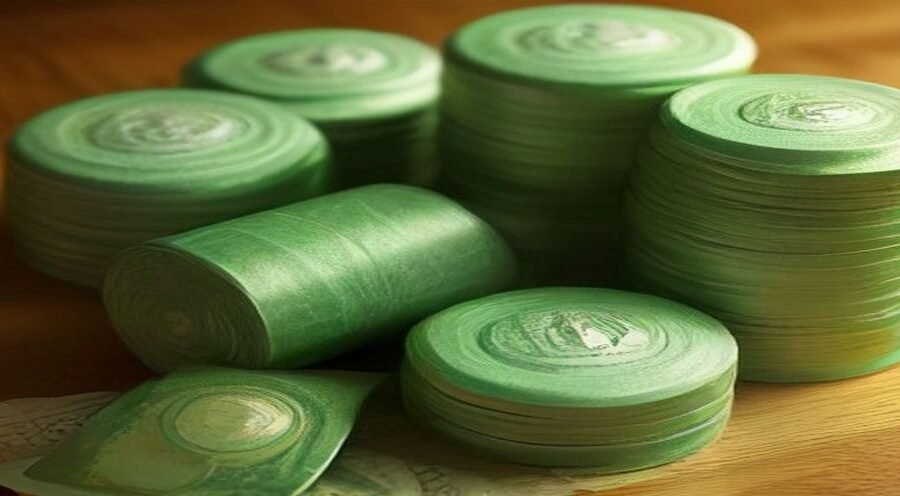
Quick answer: A standard U.S. roll of dimes contains 50 dimes with a total face value of $5.00, wrapped in a green paper wrapper. That count follows the American Bankers Association (ABA) standard used by every bank and credit union in the country, and it has not changed in decades. A full roll of modern clad dimes weighs about 113.4 grams (4 ounces), and a standard bank box holds 50 rolls — 2,500 dimes worth $250.
If you are cashing in a jar of loose change, ordering a box from your bank, or hunting rolls for silver dimes, this guide covers everything the short answer leaves out: exact counts for every dollar amount, roll and box weights, what different kinds of dime rolls are actually worth, how to roll dimes yourself, how to spot a short or tampered roll, and the silver dimes and key dates worth pulling before you spend them.
How Many Dimes Are in a Roll? The Short Answer
Every standard dime roll holds 50 dimes worth $5.00. Banks, credit unions, and coin dealers all follow the same ABA specification, so a roll you get in Florida contains exactly the same number as one in Oregon. The wrapper is always green — the ABA assigns every U.S. denomination its own wrapper color so tellers can identify rolls at a glance.
Some banks also carry half rolls of 25 dimes ($2.50), but the 50-coin, $5 roll is the universal standard — and the only one roll hunters and dealers quote prices against. If someone hands you a “roll of dimes” with a different count or a different wrapper color, count it before you accept it.
Dime Roll Facts at a Glance
Here is every specification that matters, in one place. These numbers come from the U.S. Mint’s published dime specifications and the ABA roll standard.
| Specification | Detail |
|---|---|
| Dimes per standard roll | 50 |
| Face value per roll | $5.00 |
| Wrapper color | Green |
| One modern (clad) dime weighs | 2.268 grams |
| One pre-1965 (silver) dime weighs | 2.5 grams |
| Full roll weight (clad dimes) | ~113.4 grams (4 ounces) |
| Full roll weight (silver dimes) | ~125 grams (4.4 ounces) |
| Coin diameter | 17.91 millimeters |
| Coin thickness | 1.35 millimeters |
| Reeds around the edge | 118 |
| Dimes per bank box | 2,500 (50 rolls) |
| Face value per bank box | $250 |
| Bank box weight | ~5,670 grams (about 12.5 pounds) |
The weight difference between a clad roll and a silver roll is the fastest way to spot something special: if a roll feels noticeably heavier than 4 ounces, or tips a kitchen scale past 120 grams, you may be holding 90% silver dimes from 1964 or earlier.
How Many Dimes Do You Need for $1, $5, $10, $20, or $100?
Because each dime is worth exactly ten cents, the math is simple — but it is the question people actually type into Google after the roll count itself. Here is the full conversion table so you never have to do the division again.
| Amount you want | Dimes needed | Rolls needed |
|---|---|---|
| $1.00 | 10 dimes | 1/5 of a roll |
| $2.00 | 20 dimes | 2/5 of a roll |
| $2.50 | 25 dimes | 1 half roll |
| $5.00 | 50 dimes | 1 roll |
| $10.00 | 100 dimes | 2 rolls |
| $20.00 | 200 dimes | 4 rolls |
| $25.00 | 250 dimes | 5 rolls |
| $50.00 | 500 dimes | 10 rolls |
| $100.00 | 1,000 dimes | 20 rolls |
| $250.00 | 2,500 dimes | 1 bank box (50 rolls) |
| $500.00 | 5,000 dimes | 2 bank boxes |
| $1,000.00 | 10,000 dimes | 4 bank boxes |
A useful shortcut: the number of dimes is always ten times the dollar amount. Ten dollars is 100 dimes, fifty dollars is 500 dimes, and a hundred dollars is exactly 1,000 dimes — twenty full rolls.
What Is a Roll of Dimes Worth?
Most rolls are worth exactly their $5 face value — but far from all of them. What a roll is actually worth depends on what is inside it.
| Roll type | Approximate value |
|---|---|
| Circulated modern Roosevelt dimes (1965–today) | $5.00 (face value) |
| Uncirculated recent-date rolls | $7 to $12 |
| Original bank-wrapped rolls, older dates | $15 and up |
| Roll of 90% silver dimes (1964 and earlier) | ~$188+ in melt value alone |
| Circulated Mercury dime roll (90% silver) | $200+ (melt plus collector premium) |
| Roll containing a key date or major error | One coin can exceed the whole roll |
The silver math is straightforward. Each 90% silver dime holds 0.07234 troy ounces of pure silver, so a roll of 50 holds about 3.615 troy ounces. With silver trading near $52 an ounce in early November 2026, that works out to roughly $188 in melt value alone — before any collector premium. Silver prices move daily, so always check the current spot price before valuing a silver roll; the number above is a snapshot, not a quote.
The key-date column deserves its own section, because a single coin inside an ordinary-looking roll can be worth more than the other 49 combined. That is covered in detail below.
How Much Does a Roll of Dimes Weigh?
A full roll of 50 modern clad dimes weighs about 113.4 grams, or almost exactly 4 ounces, before the paper wrapper. That number is not a guess: one clad dime weighs 2.268 grams, and 50 × 2.268 = 113.4 grams.
A roll of pre-1965 silver dimes is heavier — about 125 grams (4.4 ounces) — because each silver dime weighs 2.5 grams instead of 2.268. Across 50 coins, that quarter-gram difference per coin adds up to nearly 12 grams, which you can feel in your hand and measure on any kitchen scale.
| Roll contents | Weight per coin | Weight per 50-coin roll |
|---|---|---|
| Modern clad dimes (1965–today) | 2.268 g | ~113.4 g (4.0 oz) |
| Silver dimes (1964 and earlier) | 2.5 g | ~125 g (4.4 oz) |
| Mixed roll (roughly half silver) | ~2.38 g | ~119 g (4.2 oz) |
That weight is also your best tool for checking whether a roll is complete. A roll that weighs noticeably less than 113 grams is short — someone may have removed coins and re-crimped the wrapper. A roll that weighs noticeably more than 113 grams deserves a closer look before you spend it, because silver coins may be hiding inside.
How Many Dimes Are in a Bank Box?
A standard bank box of dimes contains 50 rolls — 2,500 dimes — with a face value of $250. A full box weighs about 5,670 grams, roughly 12.5 pounds, so it has real heft on the counter. Most banks and credit unions will order a box for you with a day or two of notice, and the teller hands it over in exchange for $250 from your account.
Serious roll hunters work through entire boxes at a time because a sealed box is the closest thing to an untouched stream of circulating coinage — every silver dime or key date inside is still waiting to be found. A single box has produced silver rolls, key dates, and mint errors worth many times its $250 face value, though most boxes simply return their face value.
Boxes exist for every denomination, and the math follows the same pattern:
| Denomination | Rolls per box | Coins per box | Face value per box |
|---|---|---|---|
| Pennies | 50 | 2,500 | $25 |
| Nickels | 50 | 2,000 | $100 |
| Dimes | 50 | 2,500 | $250 |
| Quarters | 50 | 2,000 | $500 |
| Half dollars | 50 | 1,000 | $500 |
| Dollar coins | 50 | 1,250 | $1,250 |
Every U.S. Coin Roll Compared
The dime roll is only one of six standard U.S. coin rolls. The ABA assigns each denomination a fixed coin count, a fixed face value, and a fixed wrapper color. Memorizing this table means you will never have to look a roll count up again.
| Denomination | Coins per roll | Face value | Wrapper color | Roll weight |
|---|---|---|---|---|
| Penny (1¢) | 50 | $0.50 | Red | ~125 g |
| Nickel (5¢) | 40 | $2.00 | Blue | ~200 g |
| Dime (10¢) | 50 | $5.00 | Green | ~113.4 g |
| Quarter (25¢) | 40 | $10.00 | Orange | ~226.8 g |
| Half dollar (50¢) | 20 | $10.00 | Tan | ~226.8 g |
| Dollar ($1) | 25 | $25.00 | Black | ~202.5 g |
Two things stand out. First, the dime roll is the lightest full roll in the set, even though it holds the joint-highest coin count — dimes are the smallest and thinnest U.S. coins in circulation. Second, quarters and half dollars both total $10 per roll, which is why tellers rely on wrapper color (orange versus tan) rather than value alone.
U.S. vs. Canada: Dime Rolls Compared
Canada uses the same 50-dime, $5 roll standard, so a Canadian dime roll looks almost identical to an American one at a glance. The coins inside are different, though.
| Feature | U.S. dime roll | Canadian dime roll |
|---|---|---|
| Dimes per roll | 50 | 50 |
| Face value | $5.00 USD | $5.00 CAD |
| Wrapper color | Green | Green |
| Coin weight | 2.268 g | 1.75 g |
| Coin diameter | 17.91 mm | 18.03 mm |
| Coin thickness | 1.35 mm | 1.22 mm |
| Silver cutoff date | 1964 and earlier | 1967 and earlier (mostly) |
| Full roll weight | ~113.4 g | ~87.5 g |
The Canadian dime is slightly wider but noticeably lighter than its U.S. cousin, so a full Canadian roll weighs about 26 grams less. Canadian dimes dated 1967 and earlier can contain silver, though the 1967 issue is split between silver and nickel compositions, so date alone is not enough — those coins need an edge or weight check. And the two currencies are not interchangeable: a Canadian dime roll is worth $5 Canadian, not $5 U.S., and American banks will generally not accept Canadian rolls for deposit.
Half Rolls and Other Non-Standard Rolls
The 50-coin roll is the standard, but it is not the only roll you will meet.
- Half rolls (25 dimes, $2.50): Some banks and credit unions stock half-size rolls for customers who want a smaller amount. They use the same green wrapper, just shorter. Dealers rarely quote prices for half rolls, so treat them as a convenience format rather than a collecting format.
- Machine-wrapped rolls: Produced by coin-counting machines at banks and armored-carrier facilities. The ends are crimped by machine and look uniform. These are the rolls most people receive over the counter.
- Customer-wrapped rolls: Hand-rolled by other customers, with folded or hand-crimped ends. Roll hunters prefer these, because hand-rolled coins have passed through fewer sorting machines that would already have skimmed the silver out.
- Mint rolls and sets: The U.S. Mint sells uncirculated rolls directly to collectors. These are not circulation rolls and carry a premium over face value — typically $7 to $12 for a recent-date roll.
- Short or partial rolls: A roll with fewer than 50 dimes is not a standard product. If you receive one, count it and weigh it; either someone made a counting error, or the roll was tampered with.
Why 50? The History of the Dime Roll
The 50-dime roll is a product of the American Bankers Association’s coin-packaging standard, which fixed roll sizes by denomination so that any bank, anywhere in the country, could count, store, and ship coins the same way. The standard settled on round dollar values where possible — $5 for dimes, $10 for quarters, $2 for nickels — and the dime’s ten-cent value made 50 coins the natural fit for a $5 roll.
The green wrapper is part of the same system. Each denomination got a distinct color — red for pennies, blue for nickels, green for dimes, orange for quarters, tan for half dollars, black for dollar coins — so a teller could identify a roll’s contents without opening it or reading the printed label. That color code has survived every change in coin composition since, including the 1965 switch from silver to clad dimes.
The dime itself is the smallest U.S. coin in circulation, and its size is no accident. The word “dime” comes from the Latin decima, meaning a tenth — one tenth of a dollar. The coin has carried a portrait of President Franklin D. Roosevelt since 1946, the year after his death, and the reverse shows a flaming torch flanked by olive and oak branches, symbols of liberty, peace, and strength. Its 118 reeds — the tiny grooves around the edge — are a holdover from the days when coins were solid silver: reeding made it obvious if someone had shaved metal off the edge. Modern clad dimes keep the reeds out of tradition, and the reeds are exactly what make the silver test work — a silver dime’s edge is solid silver-gray all the way around, while a clad dime shows a copper-brown stripe sandwiched between silver-colored layers.
How to Roll Dimes Yourself
Rolling dimes is simple, and banks accept hand-rolled coins without question. Neatly rolled coins are far easier to deposit, spend, or hand to the next roll hunter than a loose jar.
What you need
- 50 dimes per roll (count them first — never guess)
- Green dime wrappers (free at most banks — just ask a teller; also sold cheaply at dollar stores, office-supply stores, and online in packs of 100 or more)
- A flat table and, optionally, a small kitchen scale for a final weight check
Step by step
- Sort your dimes. Set aside any coins dated 1964 or earlier, and any coin that looks unusual — errors, odd dates, or damaged coins. Check them before they go into a roll (see the silver section below). Foreign coins and tokens do not belong in a dime roll.
- Count in stacks of ten. Make five stacks of ten dimes each. Counting in tens is far more reliable than counting straight to fifty, and a mistake shows up immediately — one stack will be short or tall.
- Count twice. Recount the five stacks before you seal anything. Two quick counts beat one careful count.
- Slide the stack into the wrapper. Hold the wrapper open, slide the column of 50 dimes in, and leave a small amount of wrapper sticking out at each end.
- Fold or crimp both ends tightly. Fold the ends flat against the coins, or crimp them with your fingers. The coins should not rattle or slide inside the wrapper.
- Weigh the finished roll. A correct roll of modern dimes weighs about 113.4 grams. If your scale reads far off that number, recount before sealing the next one.
Common rolling mistakes
| Mistake | What happens | How to avoid it |
|---|---|---|
| Counting straight to 50 | Easy to lose track and end up with 49 or 51 | Count in stacks of ten |
| Rolling silver dimes with clad ones | You spend a coin worth many times face value | Check dates before rolling |
| Leaving the ends loose | Coins slide out and the roll falls apart | Crimp both ends tightly |
| Using the wrong wrapper color | Tellers may refuse it or miscount it | Use green wrappers for dimes |
| Including foreign coins | Banks reject the roll | Sort first, roll second |
How to Check a Dime Roll: Weight, Sound, and the Edge Test
You do not need a coin dealer’s toolkit to verify a roll. Three quick checks catch almost every problem.
1. Weigh it
A correct roll of modern clad dimes weighs about 113.4 grams (4 ounces). A kitchen scale, a postage scale, or a jeweler’s scale all work. A roll weighing noticeably less is short a coin or two; a roll weighing noticeably more may contain silver dimes.
2. Check the ends
Look at both ends of the roll. The coins should sit flat and level, with no gaps and no coin sitting crooked or higher than the rest. Crimps should be tight and even. Sloppy, uneven, or re-crimped ends suggest the roll has been opened and resealed — count it before you accept it.
3. Listen and feel
Shake the roll gently. A correct roll is tight and silent. Loose coins rattle. A roll that rattles, or that feels light, deserves a recount.
4. Check the visible edges
The two end coins are visible. Their edges tell you what is inside: if you can see a copper-brown stripe on the edge, the roll is clad. If both end coins show solid silver-gray edges, the roll is worth opening and checking coin by coin.
5. Open it if anything feels off
Banks accept opened rolls. If a roll fails any of the checks above, open it and count the coins. A short roll should go back to the bank or teller who gave it to you, with the wrapper and a clear explanation.
Where to Get Dime Rolls
Getting rolls is easy — the hard part is getting the right kind.
- Your bank or credit union: The best source. Tellers hand out rolls from their drawer for face value, and most branches will order a full box with a day or two of notice. Bring your account card and ask — some branches keep limited stock on hand.
- Coin dealers and coin shops: Dealers sell rolls at face value or a small markup, and they carry the interesting ones — uncirculated rolls, older-date rolls, and original bank-wrapped rolls. Ask what is in stock; the good rolls often sit behind the counter.
- Online marketplaces: Sites like eBay sell rolls of every type, including original bank-wrapped rolls and unsearched estate rolls. Prices run higher than face value, and the “unsearched” claim on a listing is a promise, not a guarantee. Check the seller’s feedback and read the description carefully before bidding.
- Estate sales and auctions: Older rolls surface at estate sales and auctions, sometimes at face value or below. These are the rolls most likely to contain silver or key dates — and the most likely to have already been searched.
- Coin shows: Dealers at coin shows carry rolls of every kind and will often let you inspect the end coins before buying. A good place to learn what to look for.
How to Get Rolls From Your Bank
If your bank has rolls in the drawer, the transaction takes about two minutes. If it does not, a box order takes a day or two.
- Ask the teller for dime rolls. Say how many you want — one roll ($5), a few rolls, or a full box (50 rolls, $250). Tellers keep rolls in the drawer and will count them out for you.
- Pay face value from your account or in cash. A roll costs exactly $5. Some banks ask non-customers for cash and may limit how many rolls they hand out.
- Check the rolls before you leave the counter. Weigh them or check the ends while you are still at the bank. If a roll is short or damaged, the teller can swap it on the spot.
- Order a box if you need more. A full box of 50 rolls costs $250. Most banks order boxes from their vault or armored-carrier service with one or two days of notice — call ahead if you need one on a specific day.
- Build a relationship. Regulars who order boxes politely and return their searched coins neatly rolled get better service — and, sometimes, first pick of customer-wrapped rolls.
Silver Dimes in Rolls: What to Look For
Every U.S. dime dated 1964 or earlier is 90% silver — Roosevelt dimes from 1946 to 1964, Mercury dimes from 1916 to 1945, and Barber dimes from 1892 to 1916. Starting in 1965 the Mint switched dimes to the copper-nickel clad composition still used today, which is why 1964 is the cutoff date every roll hunter memorizes.
Three quick tests separate silver from clad:
- Check the date. 1964 or earlier means 90% silver — no exceptions for regular circulation strikes.
- Check the edge. A clad dime shows a distinct copper-brown stripe sandwiched between silver-colored outer layers. A silver dime’s reeded edge is solid silver-gray all the way around.
- Weigh it. A silver dime weighs 2.5 grams; a clad dime weighs 2.268 grams. On a roll scale, that quarter-gram difference across 50 coins adds up to nearly 12 grams.
One legendary exception exists: a tiny number of 1965 dimes were accidentally struck on leftover 90% silver planchets during the changeover. Authenticated examples are worth $5,000 or more — so if your 1965 dime weighs 2.5 grams and shows a solid silver edge, have it professionally authenticated before spending it.
Key dates and errors worth pulling from dime rolls
Silver is the most common score, but the real prizes are key dates and mint errors hiding in ordinary rolls:
| Coin | Why it matters | Approximate value |
|---|---|---|
| 1916-D Mercury dime | Only 264,000 struck at Denver — the king of dime roll finds | $1,000+ even heavily worn |
| 1921 and 1921-D Mercury dimes | Low-mintage issues | $50+ in circulated grades |
| 1942/1 and 1942/1-D Mercury dimes | A 1 punched over a 2 in the date | $300+ with clear doubling |
| 1945-S Micro S Mercury dime | A tiny mint mark variety most searchers overlook | $15+ |
| 1982 No-P Roosevelt dime | Philadelphia accidentally omitted the P mint mark | $75+ for strong examples |
| 1996-W Roosevelt dime | Struck at West Point, issued only in 1996 mint sets (1,457,000 minted) | $10+ if one escaped into circulation |
| Off-center strikes and broadstrikes | Dramatic mint errors | $20+, wilder examples higher |
| 1965 silver transitional error | Struck on a leftover silver planchet | $5,000+ authenticated |
When you spot a candidate, have it authenticated or checked against a reliable key-date reference before spending it or selling it — a single coin in the wrong pocket can cost you hundreds of dollars.
What to Do If You Find a Silver Dime
Finding silver in a roll is the moment every roll hunter works for. What you do next depends on what you found.
- A common-date silver Roosevelt dime (1946–1964): Worth its melt value — roughly $3.50 or more per coin at early-November 2026 silver prices. Most hunters keep these in a tube or jar as a silver stack, since the value only exists if you sell.
- A Mercury or Barber dime: Worth melt value plus a collector premium, and more if the date is scarce or the condition is strong. Keep it separate and handle it by the edges.
- A key date or error: Do not clean it, do not spend it, and do not sell it to the first buyer. Get it authenticated and graded if the value justifies it — cleaning a collectible coin can destroy most of its value.
- A full roll of silver dimes: Worth roughly $188 or more in melt value alone at early-November 2026 prices. Selling options are a local coin dealer (fast, pays slightly under melt), an online bullion buyer (often closer to melt, but with shipping and waiting), or keeping the roll intact (original rolls of silver dimes carry a premium over loose coins).
- A single silver dime mixed into a clad roll: Set it aside and spend the rest. One silver dime is a find, not a fortune — but it is proof the roll stream you are searching still carries silver.
Frequently Asked Questions
How many dimes are in a roll?
A standard U.S. roll of dimes contains 50 dimes with a face value of $5.00, following the American Bankers Association standard used by every bank. The wrapper is green, and a full roll of modern clad dimes weighs about 113.4 grams.
How much is a roll of dimes worth?
A roll of circulated modern dimes is worth its $5 face value. Uncirculated rolls bring $7 to $12, original bank-wrapped older rolls $15 and up, and a roll of 90% silver dimes (1964 and earlier) carries roughly $188 or more in melt value at early-November 2026 silver prices, before any collector premium.
What color is the wrapper on a roll of dimes?
Green. The American Bankers Association assigns green wrappers to dime rolls, blue to nickels, red to pennies, orange to quarters, tan to half dollars, and black to dollar coins.
How many dimes come in a bank box?
A standard bank box holds 50 rolls — 2,500 dimes — with a total face value of $250 and a weight of about 12.5 pounds. Most banks will order one for you with a day or two of notice.
Are old dimes worth more than 10 cents?
Yes — if they are dated 1964 or earlier. Those dimes are 90% silver and worth roughly $3.50 or more each in melt value alone at early-November 2026 silver prices, before any collector premium. Modern clad dimes dated 1965 or later are worth their 10-cent face value, except for rare errors and key dates.
Can I deposit a roll of dimes at the bank?
Yes. Banks accept full rolls of 50 dimes, and most accept hand-rolled coins as well as machine-wrapped rolls. Some banks ask for rolled coins to be deposited into an account rather than exchanged for cash, so bring your account card.
How many dimes are in a half roll?
A half roll holds 25 dimes with a face value of $2.50. Half rolls use the same green wrapper in a shorter size and are stocked by some banks and credit unions.
What is a dime roll worth at a pawn shop?
A pawn shop typically pays slightly under melt value for a silver roll — often a few dollars less than a coin dealer would. For a standard clad roll, you will get its $5 face value at most. A coin dealer or online bullion buyer is usually the better option for silver.
Why are dime wrappers green?
The American Bankers Association assigns each U.S. denomination a distinct wrapper color so tellers can identify rolls at a glance. Green means dimes; red is pennies, blue is nickels, orange is quarters, tan is half dollars, and black is dollar coins.
Do banks still give out rolls of dimes?
Yes. Most banks and credit unions keep rolls in the teller drawer and will hand them out for face value. If they are out of stock, they can usually order a box of 50 rolls with a day or two of notice.
The Bottom Line
A standard roll of dimes holds 50 dimes worth $5.00 in a green wrapper. That is the number to remember — and the starting point, not the whole story. A roll’s weight (about 113.4 grams for modern clad coins, about 125 grams for silver) tells you whether it is complete and whether silver might be hiding inside. A bank box holds 50 rolls, 2,500 dimes, worth $250. And every roll is a small lottery ticket: most are worth exactly $5, but a silver dime, a key date, or a mint error inside can turn an ordinary roll into a find worth hundreds or thousands of dollars. So check the dates, check the edges, and weigh your rolls before you spend them.
Prices for silver and collectible coins change daily and are shown here as approximate values at early-November 2026 market levels. Verify current spot prices and seek professional appraisal before buying or selling.
